Unapologetically Gray: Why More Black Women are Embracing the Silver
For decades we were told to cover it up. Now, a growing movement of Black women is reclaiming the gray, and it’s one of the most radical acts of self-love we’ve seen in a generation.
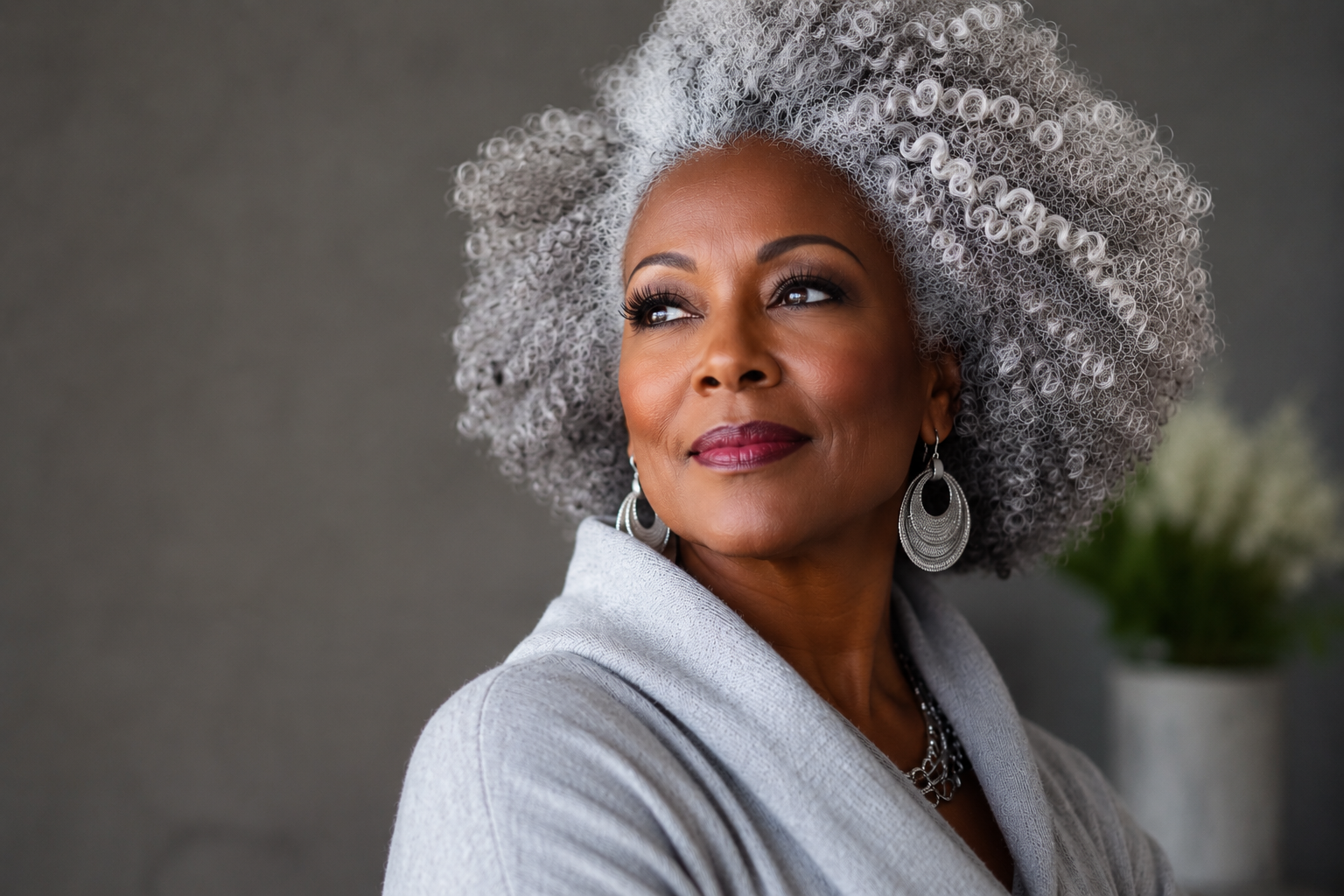
She walked into the room and every head turned. Not because she was the youngest woman there, but because she was the most luminous. Her silver locs cascaded past her shoulders, catching the light like polished pewter. She was 58, unapologetic, and absolutely breathtaking.
That image — of a Black woman fully, boldly gray — is one that’s becoming more common. And for many of us who grew up in households where “keeping up” meant keeping every gray hair covered, it feels almost revolutionary.
The Weight of the Dye Box
Let’s be honest: the cultural pressure for Black women to color their gray has been relentless. It’s come from family tables, corporate boardrooms, and beauty industry messaging that equated youth with worthiness. For generations, going gray was treated less like a natural milestone and more like a failure — something to be fixed, hidden, corrected.
The beauty industry has made billions off that pressure. Box dye. Salon appointments every four to six weeks. Touch-up kits. Root concealers. The math adds up to thousands of dollars over a lifetime spent managing something that was never a problem to begin with.
But gray is not the absence of beauty. It is beauty in its most earned form. But something has shifted. Women, Black women especially, are opting out. And they’re not being quiet about it.
The Silver Wave is Here
Social media has become an unexpected catalyst. Instagram and TikTok accounts dedicated to natural gray hair on women of color have amassed hundreds of thousands of followers. The hashtag #GrayHairDontCare has millions of posts. What was once a private decision made quietly in a bathroom mirror has become a public declaration.
The women leading this movement aren’t backing down from the world, they’re walking into it more confidently than ever. They’re CEOs, artists, educators, grandmothers, and first-time entrepreneurs. They’ve stopped waiting for permission to look exactly as they are.
And the texture conversation is inseparable from the color one. For Black women with natural hair, transitioning to gray often means embracing both the silver and the curl pattern simultaneously, a double act of defiance against beauty standards that have long excluded them.
What the Transition Really Looks Like
Growing out years of color is not always a graceful process, and it’s important we tell that truth. The “grow-out” phase — that in-between stretch where your roots are silver and your ends are dyed — can feel awkward. Some women cut it all off in a big chop. Others use highlights or low-lights to blend the transition. Some simply hold on through the awkward months and call it a practice in patience.
What many women report on the other side of the transition is something unexpected: relief. The maintenance schedule that once governed their lives quietly disappears. The money they were spending reallocates itself. And perhaps most profoundly, they stop fighting their own reflection.
The Cultural & Political Dimensions
This is not just about hair. For Black women, the decision to go gray is wrapped up in a much larger reckoning with who we’ve been told to be. Aging gracefully, in mainstream culture, has historically been coded as aging invisibly — shrinking, softening, disappearing. Refusing to hide the gray is, in many ways, a refusal to disappear.
It is also connected to the growing natural hair movement, which has been challenging Eurocentric beauty standards for decades. The same consciousness that led Black women to put down the relaxer is now leading some of us to put down the dye. The roots of the movement — pun fully intended — run deep.
“I stopped coloring my hair the same year I stopped apologizing for taking up space. I don’t think that’s a coincidence.”
Caring for Gray Hair on Melanin-Rich Skin
Gray hair has a different texture than pigmented hair. It tends to be coarser, drier, and more porous — which means it requires intentional moisture.
Here’s what beauty experts recommend for Black women navigating silver strands:
Deep condition weekly. Gray hair is thirstier than pigmented hair. A rich, protein-balanced deep conditioner used consistently will maintain elasticity and shine. Look for formulas with shea butter, argan oil, or aloe vera.
Use a purple or blue toning shampoo. Environmental factors can cause gray hair to look yellow or brassy. A toning shampoo used once or twice a month keeps silver looking crisp and luminous. Don’t overuse it — too much toner can leave a lavender cast.
Seal with oils. Because gray hair is more porous, it loses moisture faster. Sealing with a lightweight oil, such as jojoba, sweet almond, or a hair elixir after styling, locks in hydration and adds the kind of sheen that photographs beautifully.
Protect at night. A satin bonnet or pillowcase is non-negotiable. Gray hair that is not protected overnight can wake up dry, frizzy, and dull.
Trim regularly. Gray hair can be more prone to single-strand knots and split ends. Regular trims (every eight to ten weeks) keep your style looking intentional and healthy.
To Gray or not to Gray: It’s Always Your Choice
We want to say this clearly: there is no wrong answer here. If you love your color appointments, keep them. If the ritual of the salon chair brings you joy, honor that. Beauty is personal, and HOPE has never been in the business of prescribing one way to be a woman.
But if you’ve been covering your gray out of fear — fear of looking old, fear of being passed over, fear of what your mother or your colleagues or the internet might think — this is your permission slip to reconsider.
Your silver is not a sign that your best years are behind you. It is evidence that you have lived, that you have weathered things, that you are still here — radiant and unfinished and full of more story to tell.